

Finding an Up-to-date Approach to Cleaning Sheep Fibre
We thank member Felicity for creating this article for the interest of our members.
Whilst all sheep vary according to breed and individual (and even from year to year), it may help to generalise about the typical characteristics of parts of the fleece. Whilst professionals who grade fibres are knowledgeable about the trade and what known large-scale buyers will pay, there is also much for small-scale weavers, spinners and dyers to learn about what uses can be made of different grades of fibre selected from a single fleece.

No amount of theory learned can replace practical experience gained by working for a long time with different types of fibre.

Every fleece gets dirty so it’s a good idea to have a few rules of thumb about cleaning them. First assess the qualities of the particular fibres you are working on, next try to identify all the different types of residue that must be removed. Find the best way to clean away each type, and then take action.
Work on a small handful of fibre at a time.
Clean the fibre as much as possible whilst still dry.
Move the fibres as much as possible when they are warm because this will help them to shrink before they are spun, knitted or woven into items that you wish to remain the same size.
So, what might we be trying to remove from raw fleece fibres?
(1) A fleece might contain parasitic insects, germs, diseases, or medication applied by immersion in a sheep bath. To make matters worse, the fibres develop static attractions to many things whilst repelling each other so even good fibres may need to be treated like waste.
(2) There are likely to be clumps of fibre glued together with dried pastes made of mud, blood, dung and urine.
(3) Wool fibres get tangled and the spring-like nature of their crimps and segmented parts lock them together with pressure. This provides strength and insulation. Hair and kemp fibres of unwanted colour, diameter & texture may get bound into the wool but, aside from the dirt that gets absorbed into the spongy centres of the kemp, these fibres may be unwanted.
(4) Tiny twigs, bits of plant, and seeds, can catch the fibres, knot them together, and cause them to wrap into clumps. If they are spun into the yarn they will be increasingly problematic with successive washes as they biodegrade.
(5) The tackiness of natural greases released from glands in the sheep’s skin also sticks the fibres together, encapsulating them in oily films which merge when they touch.
How might we tackle these problems?
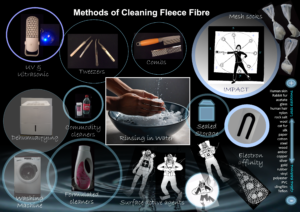
(1) be aware of whether different materials have a greater positive or negative charge than fleece, try to balance-out any unwanted effects, and avoid rubbing the fibres against anything. Use static (otherwise known as electron affinity) to store fibres in plastic wrap for a couple of years so that any parasites, germs, diseases and drugs are rendered harmless before handling (just remember to ensure that all the fibres are first dried and dehumidified – the presence of water will result in unwanted chemical reactions).
(2) Gather together the clumps of fibres that are glued, and break down the dried pastes with “impact”. For example, take a strong mesh sock, wrap the clumps around a tennis ball, and place this in the end of the sock. Standing with your back against a solid wall, bounce the ball against the wall in a pattern of eight directions (1, 5, 2, 6, 3, 7, 4, 8) to exert pressure and reduce the clots to dust. Repeat for as long as necessary, reversing the sequence if transferring the sock to the other hand.
(3) Gently tease apart the fibres with strong combs, trying not to tear them.
(4) Some organic matter might also be removed by combing, but patient use of tweezers and fingers to pull the bits away is the usual remedy.
(5) The natural greases can only be removed with the assistance of water, but water alone is not enough. Do not leave fleece fibres soaking in water because any organic residue may form toxic, flammable marsh gases and result in the fibres breaking down.
As animal fibre, fleece is formed of proteins, which are in turn formed by amino acids. Therefore, sheep fibres are naturally acidic and they are broken down when exposed to alkaline solutions, such as those formed by bicarbonate of soda, salt, or washing-up liquids. Although these might remove unwanted residue, they will also weaken the fibres. This is a reason why vinegar is used instead of salt when dying animal fibres, but the vinegar acts as a mordant and not a cleanser so any staining is likely to be fixed instead of removed.
Even soap suds, the traditional method of cleaning, may do more harm than good. Especially in areas where the water is hard, the suds will add more unwanted chemicals to the yarn than they take away, ruining their texture and leaving an unpleasant smell.
So avoid soaking fleece fibres in commodity cleaners too, or restrict their use to a few affected fibres only. Instead, it is more effective to use a formulated cleaner that suits the type of fibre you are cleaning, whether it is a gentle PH-neutral shampoo or a special wool formula.
Formulated wool cleaners contain numerous surface active agents (surfactants) and other chemicals that specifically target the types of residue that are likely to be there. The fibres can be left to soak in this solution until the water appears very cloudy, which is a sign that sufficient numbers of cleaning molecules have attached themselves to the residue for the unwanted dirt to be carried away in the water when the fibres are drained.
A second soak in a Formulated wool cleaner may be needed for the dirtiest parts of the fleece, but most of the fibres are likely to be clean.
Surfactant molecules are chain-like. They have a hydrophobic (water hating) end that grips dirt, and a hydrophilic (water loving) end which pulls the rest of its chain with it when poured away. The hydrophilic part of a surfactant molecule may be likened to a deep sea diver who is a combatant in one of four underwater battalions that work together to remove dirt. Some have a positive charge, some have a negative charge, some have a neutral charge, and others have the ability to use a positive, negative, or neutral charge depending upon the conditions they discover when they are released into the water.
The hydrophobic part of a surface active agent may be likened to a net that pulls in dirt and doesn’t let it out again.
On the microscopic scale, dirt molecules are too small and great in number for a life-size person to handle. So, whilst there is an expense to pay for removing the oily residue from fleece, hand over all the hard work to the experts.
